Monday, September 24, 2012

Making an Inference - What's in the black box?

Black Box Hypothesis

Students in class have been investigating the black box. They only have the science process skills we've been practicing in class and access to colored water to explore the mystery of the black box. The students have formulated some great hypotheses regarding the mechanics that would cause the black box to act the way it does.


student work
Student idea of what is inside the black box.

Thursday, September 13, 2012

Black Box Mystery

The black box used in 8th grade science.
In class we are examining the water exchanger device. We are calling this the black box activity because we really don't know what is inside the box. The following is a description about black boxes from Wikipedia:
In science and engineering, a black box is a device, system or object which can be viewed solely in terms of its input, output and transfer characteristics without any knowledge of its internal workings, that is, its implementation is "opaque" (black).
As I showed the class today, when I put 100 mL of water in the funnel only a small amount of water <5 mL came out. 

What is mysterious about the black box? 

What would you like to know more about the black box? 

Leave a comment about the black box!

http://en.wikipedia.org/wiki/Black_box

Thursday, September 22, 2011

Rocket Science


We have been spending a lot of class time talking about motion and exploring the velocity and acceleration of objects. Today, for an extreme velocity and acceleration, the class watched and examined the launch of Space Shuttle Discovery for STS-133. This was the last voyage of the craft which was retired this past summer. Watch the video again!

Wednesday, September 14, 2011

Sea Ice Project

Today the students completed a study of the impact of melting ice on water levels. I choose this particular topic because of the number of variables involved usually causes each group to come up with different conclusions.  Also, this is a real-world problem that scientists are observing.

In today's Washington Post, it was reported that sea-ice was at its lowest volume in record (1971-2010). Click here to read more! You may ask "why is this important?" Well, the Arctic Ocean is part of the global conveyor of water. Warmer water from the equatorial oceans moves north. While cold water moves south from the north, the currents help to influence cloud formation. This conveyor moves thermal energy throughout the planet creating the various seasonal patterns and climates. 

Beyond weather, the arctic is an important zone for wildlife. Obviously, polar bears, seals and sealions depend on the Arctic ice for survival. But you can add several whales, walruses, and Native Alaskans to the list of those that depend on the Arctic ice. A very telling graphic also appeared on the website and is linked below:

Sunday, September 11, 2011

Greener Classroom

Science 8 Classroom

 What does a green classroom look like? One of my goals this school year is to consider the amount of environmental waste that my students and I produce during the course of the school year. The science laboratory alone has a large volume of waste just by the very nature of the activities that the students are engaged. But there is a lot that I think I can do to make big changes here at school. Here are few things that I've started to be a little bit greener.

One of the online activities for students to complete replacing
on that was once completed with paper and pencil.


Science Notebook - Students are required to use a science notebook. My thoughts on the science notebook are two-fold. First, the students will be more engaged in the content because they are both creating and using the materials for the class. But the added effect, is that we will use less paper by not producing photocopyies. I have found that too much of the paper that we photocopy for the classroom can become a disorganized mess. But, the science notebook may be a great way to introduce order to class materials as well as lessen the impact on the environment by eliminating much of the regular photocopying.

Online Activities - Another way to reduce the amount of printing and paper that we use this year is through the class website. I am trying several means to collect student work electronically. This will no doubt eliminate the need for the copying or printing of assignments. Using the parent/student portal website, I am also able to post work in a manner that only the particular student can see his/her work.

Energy - As much as possible, I am making a conscience effort to turn off unused equipment, lights, and electronics. This will lessen the use of electricity.

As the year progresses, I am going to brainstorm more ways to make my classroom greener. If you have any ideas about reducing my impact on the environment, let me know with a comment!

Thursday, September 08, 2011

Problem on the Way to Mars

From Hassard, J. (1999) Science as Inquiry. Good Year Books, Parrisany, NJ

How we solve complex problems through teamwork is an important part of science. Today my classes explored a problem where they were astronauts stranded on the moon's surface. Students had several "recovered" items that they could use for their survival. The student teams had to determine what objects were worth keeping and what was not useful for their survival. The decisions to be made required both observation of the items and inferences about how they would be useful on the moon's surface.

From Hassard, J. (1999) Science as Inquiry. Good Year Books, Parrisany, NJ

This exercise is useful in helping students to understand that not all science is conducted in a lab or through an experiment. Useful information can be gained by making observations, engaging in imaginative discussion, and solving complex, multistep problems.


Homework Tonight:
A3 Brief Constructed Response due Friday
A4 Quiz Online
due Friday

Upcoming Dates:

Unit Test Wednesday

Wednesday, September 07, 2011

Being Part of an Experiment in Education

Today the students were introduced to the Concord Consortium's study that involves our laboratory in the SmartGraphs program pilot. I did my best to explain how this type of investigation relates to what we've been learning in class. The following is a recap:

The students are the experimental group because they are among a few to use the SmartGraph program pilot. They will be compared to other students in similar Pennsylvania schools (a control group) that are not working on SmartGraphs, but covering similar topics. The SmartGraphs software and hardware are the independent variables. To evaluate whether SmartGraphs is an effective learning tool, the students will take pre-tests and post-tests. The scores on the tests will be the dependent variable. What will the conclusion be? Well, that will depend on the results of the pilot.

Hopefully, the SmartGraphs program will be a success and students throughout the United States will benefit from the investigation taking place in our science laboratory. My experiences with the SmartGraphs program so far has exceeded my expectations and I look forward to the students working with this pilot program.


Parents who would like to learn more about SmartGraphs can read the letter from the researchers.

Upcoming Dates: 


Tuesday, September 06, 2011

Scientists are Skeptics

Patterson "Big Foot" Video. Available on YouTube: http://youtu.be/IJjUt2sXo5o


Scientists are skeptics because they are doubtful and do not readily accept ideas or theories. To illustrate this point, the class examined the Patterson Big Foot video which is available on the internet. The students discussed what would make the big foot story credible. The described the evidence that they would need to affirm an understanding about the existence of big foot. The students were also introduced to the methods by which scientists classify new ideas into scientific theories and scientific laws.


Upcoming Dates: 


Friday, September 02, 2011

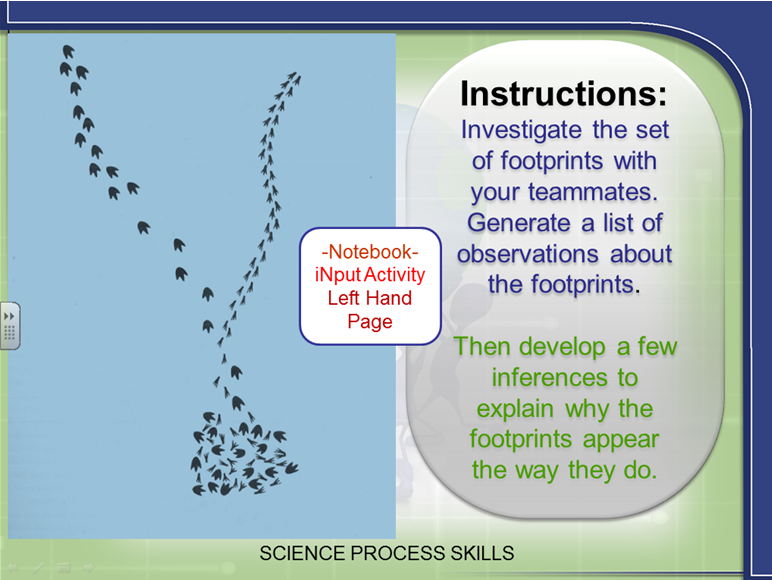
Footprints and science problem solving

Footprints through inquiry and problem solving.

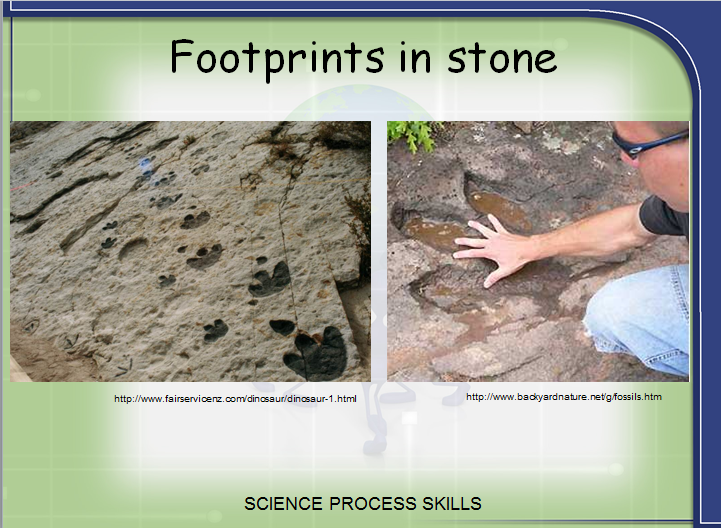
Today the students went further in their exploration of scientific problem solving by considering observation and developing inferences. The footprints were part of an activity that was published in the 1960's. However, the content is very relevant because it sparks questioning, observation and developing hypotheses.

Pictures from the internet used in class.


Want to learn more? Try searching the web for more pictures like those shown in class!


Homework Tonight:

None

Some classes have not yet received these assignments.


Thursday, September 01, 2011

Science Process Skills

Picture from today's activity.

In class today, the students and I focused our attention on the way we learn information in science. We used a picture that I found on the internet. The students made a list of things that  they could tell me about the picture. From that list,. we were able to describe the differences between observations and inferences. It is obvious that the students in the picture are on a field trip. According to the website, the students are getting onto the bus after a field trip to the Colorado National Monument.

Today we also started to setup the science notebook. Students copied the first set of notes into the notebook. You can find the notes on the website under notes and learning section of the unit resources. No homework was assigned tonight, but assignments are available online for students and parents.


Homework Tonight:

None


Wednesday, August 31, 2011

First day of school

Happy New Year, The Haskins-Science Lab
Today was the first day of school and it was great meeting all of my new students. I think this year will be a great adventure in learning. Though today was mostly about the lab space and the hazards and safety precautions, the students seemed interested in the projects that are planned for the new school year.

Read more about class expectations and procedures on the website by clicking here! 


Homework Tonight:

Obtain a spiral-bound notebook with at least 100 sheets
Return Emergency Card
Parent Pamphlet


Upcoming Dates:


Monday, July 11, 2011

Developing the Science Notebook

As the summer season rolls on, I thought I would share some of my plans for the science notebook that is to be used in the 2011-2012 school year. I am developing an interactive notebook for the students to use throughout the school year. It is to be a combination of journal, note-taking, experimentation, and archive for students to create.

In the past, students have mostly collected photocopies of assignments and placed them into a three-ring binder. After completing assignments or taking notes from class, they did very little reflection on the content. This may be due to the fact that students seemed to be bombarded with photocopies. The organization and storage of these papers has been an issue because the binding holes tend to rip, papers get shoved into the binder's pockets, or lost all together.

With the new science notebook, students will use more self-designed graphic organizers and structure their ideas in the notebook. The notebook will have more rigid requirements and students will pay closer attention to what needs to be placed into the notebook. The entries into the notebook will be crafted to help students to solve a scientific problem. Students will be using the notebook to organize pertinent information as they complete tasks. The science notebook will contain the information to help students explain the significance of scientific phenomena that is observed in the laboratory or in the real world.

To prepare the science notebook, I am working on the logistics. Such as how to introduce and model for the students how to add entries, extend entries, and reflect on what is learned. I also need to develop the grading methods and procedures for the notebook. I look forward to seeing how the new science notebook will extend learning in the upcoming school year.

Friday, June 03, 2011

Thanks for a great year!


I would like to extend a very heartfelt thanks for a great first year! We ended the school year with a little competition. Students participated in my version of "Minute to Win It." It was a lot of fun (both the game and the school year)!


Students, be sure you work hard and play nice in high school. You will do great things. But first, have a SAFE, FUN summer!

Friday, May 27, 2011

End of the School Year

As the school years begins to wind down, the last assessment will take place on Tuesday, May 31, 2011 for all students. Students should review their notes from the unit "waves" which included sound and electromagnetic waves. Students can also use their science notebooks on the test. Students should remove all papers from the notebook except items from unit H.

Thanks for a good year! Good luck in high school!

Wednesday, May 11, 2011

Learning about Waves


In class we have been looking at types of waves and wave properties. Students have spent some time examining waves in a rope. Specifically, the students are learning about the relationship of wavelengths and frequencies of waves. This will be related to other types of waves we will be exploring later next week. Both light waves and sound waves are directly affected by their frequencies and wavelengths.

"Why do we have to learn this?" was a question that was posed by a student. Of course learning about waves seems tedious, but it does have implications on everyday life. Amplitude, frequency have a direct relationship on pitch, tone, and volume in music. Also, learning about waves helps us to differentiate among different types of light. Ultraviolet light and gamma rays are often mentioned in the news, but we often don't have an appreciation how they are different. 


Period A-F
Period H
Due today:

H1 Reading Activity Chapter 10
Today:

H4 Quiz
Next assignments:

Extra Credit: VocabTV due Friday
H3 Homework: Properties of Waves due Friday
H4  Quiz: Properties of Waves on Tuesday
Next assignments:

H6 Reading due Thursday

Friday, April 29, 2011

Layered Curriculum: Level A

Students should be working on level A assignments for the layered curriculum. In order to complete the online quizzes, students must log-in using their Edline account from the beginning of the school year. Parent accounts will say "read only." All students will take the unit test at the end of the layered curriculum.

Layered Curriculum Update

Assignments are available for download at the following website: http://home.comcast.net/~mrhaskins/resources.html#B 


Update


Layered curriculum due May 2, 2011 (period H)

Layered curriculum unit test May 3, 2011 (period H)

Layered curriculum due May 4, 2011 (periods A through F)

Layered curriculum unit test May 5, 2011 (periods A through F)

Wednesday, April 13, 2011

Assignments Available Online & Broken Links Fixed

A few "bugs" in the website have been fixed. Currently, all of the assignments are available for download if they have a worksheet or word document icon on the list of assignments. As the students have  been working on layered curriculum assignments, a few online problems have occurred:

  1. Edline Accounts. Students must have their own account. I helped students setup accounts back in October. But some did not setup their accounts and must do so to complete C15, C16, C17, A6, A7, A8, A9 & A19. 
  2. Broken Links. A few of the assignments did not have functioning links. At this time, I think most of the links are working on the website. If you have any issues, please leave a comment below or send me an email.
  3. Time line. Students should be working toward the goal where they will be completing all Level C assignments by Friday. Currently, 20% of the students in the eighth grade have completed Level C.  
  4. Cookie Errors on Edline. I have not determined what the issue is with Edline and Internet Explorer. It is suggested that students use another internet browser program due to a specific error message that the students have been getting through the IE program.

Labs Today:

Periods A through F
Period H
B.4 Simple Machine Safari
B.5 Pulley Lab
B.7 thermal Transfer Lab
B.6 Simple Machine Workstations
B.8 Electroscope Lab

B.9 Simple Circuit Lab

Assignments are available for download at the following website: http://home.comcast.net/~mrhaskins/resources.html#B 


Update


Layered curriculum due April 28, 2011 (period H)

Layered curriculum unit test April 28, 2011 (period H)

Layered curriculum due May 4, 2011 (periods A through F)

Layered curriculum unit test May 5, 2011 (periods A through F)

Tuesday, April 12, 2011

Layered Curriculum assignments continue

The students in science class continue to work on their layered curriculum. Today's classes were offered activities exploring simple machines and electricity. Most of the "Level B" activities must be completed in class. Here is a list of labs currently being offered for students to complete:


Periods A through F
Period H
B.4 Simple Machine Safari
B.5 Pulley Lab
B.7 thermal Transfer Lab
B.6 Simple Machine Workstations
B.8 Electroscope Lab

B.9 Simple Circuit Lab

Assignments are available for download at the following website: http://home.comcast.net/~mrhaskins/resources.html#B 


Update


Layered curriculum due April 28, 2011 (period H)

Layered curriculum unit test April 28, 2011 (period H)

Layered curriculum due May 4, 2011 (periods A through F)

Layered curriculum unit test May 5, 2011 (periods A through F)

Science 8 Archive

Followers